EBAC HIC Method · 8 weeks live

Bring a real AI decision from your company. Leave with an implementation case ready for executive decision.

In 8 weeks, learn to identify where AI really creates value, structure the problem, align business, people, risk and technology, build and test a solution, and decide with evidence what to implement, adjust or stop.

I want to bring it to my company

8 weeks live · 16 sessions · 4 individual mentoring sessions · 1 cumulative case

8
weeks live
16
sessions
4
individual mentoring sessions
1
cumulative case
How to join

Individually or with your company

Join to build your own capability to lead AI implementation, or train several leaders with a common method on real organizational problems.

I want to become able to lead AI implementation

For leaders who want to turn AI opportunities into structured executive decisions.

  • Bring a real challenge from where you work
  • Connect business, people, technology and risk
  • Build a demonstrable implementation case
  • Develop a reusable method
  • Gain repertoire for greater AI responsibility
I want to join the next cohort

I want to develop leaders with a common method

For organizations that want to train leaders from different areas while working on real company challenges.

  • Common language across business, people and technology
  • Several real cases structured with the same method
  • Comparable criteria and shared quality gates
  • Internal champions and a next-steps pipeline
I want to bring it to my company
By role

What changes for your executive role

The program answers different problems by role. Explore what each profile decides, develops and builds — the real AI decision stays the common core.

CEO / Founder / General Manager

Separate hype from value and set investment priority.

See problems, learning and deliverable

Problems

  • Many possibilities, little prioritization
  • Pressure to invest in AI
  • Hard to separate hype from value
  • Individual productivity without clear impact

You learn

  • Identify where AI deserves executive attention
  • Assess value, feasibility and risk
  • Ask better questions to technical teams
  • Define investment criteria

You build

  • Business case
  • Decision memo
  • Prioritization criteria
  • Roadmap

Director / Business Area Head

Turn operational pain into an implementable problem.

See problems, learning and deliverable

Problems

  • Knows the pain but can't turn it into a project
  • Local automations don't change process
  • Vendors arrive with solutions before diagnosis
  • Little baseline

You learn

  • Turn pain into an implementable problem
  • Map workflow and create a baseline
  • Design human + AI workflow
  • Set metrics

You build

  • Use case
  • Redesigned workflow
  • Pilot
  • Evidence plan

HR / People / L&D

Move from 'AI training' to capability strategy.

See problems, learning and deliverable

Problems

  • Generic 'train AI' demand
  • Different maturity levels
  • Policies disconnected from practice
  • Individual productivity doesn't become collective capability

You learn

  • Capability diagnosis
  • Audience segmentation
  • Problem-connected training
  • Transfer and adoption

You build

  • Capability map
  • Development plan
  • Adoption criteria
  • Multiplier model

Innovation / Transformation / AI Lead

From POCs to portfolio and implementation discipline.

See problems, learning and deliverable

Problems

  • Huge backlog and too many pilots
  • POCs without decisions
  • Little connection to operations
  • Hard to compare value/risk

You learn

  • Opportunity portfolio
  • Prioritization and experiment design
  • Quality/evidence gates
  • Stop / iterate / scale

You build

  • Opportunity portfolio
  • Pilot
  • Evidence gates
  • Decision model

CIO / CTO / Data / Technology Leader

Connect architecture to the problem and executive decision.

See problems, learning and deliverable

Problems

  • Areas ask for AI without requirements
  • Shadow AI
  • Unclear data and integrations
  • Late security

You learn

  • Translate business into requirements
  • Assess architecture and integration
  • Take part in build/buy
  • Structure proportional controls

You build

  • Architecture decision
  • Risk/data requirements
  • Feasibility assessment
  • Integration roadmap

Consultant / Advisor / PMO

From the deck to an implementation methodology.

See problems, learning and deliverable

Problems

  • Client starts from the tool
  • Unstructured diagnosis
  • Hard-to-implement recommendations
  • Lots of deck, little evidence

You learn

  • Diagnosis and scoping
  • Prioritization and pilot design
  • Stakeholder management
  • Evidence-based decision

You build

  • Diagnostic
  • Implementation case
  • Stakeholder map
  • Decision package
Organizational maturity

Where is your organization today?

Segmentation is by AI adoption stage, not industry. Explore what each stage faces and what the program develops.

We are experimenting

People already use AI, but individually.

See context and application

What is usually blocked

  • Individual use without method
  • No common language
  • No baseline

What the program develops

  • Identify relevant problems
  • Create a common language
  • Define first criteria

What can be built

  • Problem brief
  • Baseline
  • Initial criteria

We are organizing

Several tools and initiatives, little consistency.

See context and application

What is usually blocked

  • Duplication
  • No ownership
  • No proportional governance

What the program develops

  • Prioritization
  • Clear ownership
  • Tool criteria

What can be built

  • Priority matrix
  • Proportional governance
  • Tool criteria

We are implementing

Cases are chosen but must move from concept to pilot.

See context and application

What is usually blocked

  • No clear workflow
  • No data/risk requirements
  • No prototype

What the program develops

  • Solution design
  • Data/risk requirements
  • Evidence gates

What can be built

  • Workflow
  • Prototype
  • Evidence plan

We already have pilots

We must decide what to fix, stop or scale.

See context and application

What is usually blocked

  • No baseline comparison
  • No economics
  • No operating model

What the program develops

  • Baseline comparison
  • Economics
  • Stop / iterate / implement / scale

What can be built

  • Decision model
  • Operating model
  • Roadmap
Bring your problem

Which AI decision is stuck in your company?

You don't need to know which tool solves the problem. The program starts before the tool.

Opportunity and priority

  • where to apply
  • portfolio
  • build/buy
  • prioritization
  • business case

Process and productivity

  • workflow
  • handoffs
  • tasks
  • automation
  • rework

Data, technology and risk

  • data
  • integration
  • privacy
  • security
  • compliance

People and capability

  • training
  • roles
  • champions
  • multipliers
  • adoption

Pilot and implementation

  • prototype
  • experiment
  • quality gates
  • validation
  • readiness

Value and scale

  • baseline
  • metrics
  • economics
  • rollout
  • stop/iterate/scale

Your problem is not on the list? Bring it anyway.

The real problem

Experimenting with AI got easy. Deciding what deserves implementation stays hard.

Tools already let individuals and areas test new ways of working quickly. The executive challenge is turning experiments into decisions: which problem is worth solving, which evidence matters, which risks must be controlled and what deserves investment, adoption or scale.

⚠️

Many initiatives, little prioritization

Ideas and tools appear faster than the organization can evaluate them.

🔧

Individual productivity, unchanged process

People can work faster while handoffs, decisions and workflows stay unchanged.

📉

Pilot without decision

A working demo alone does not answer whether something should be implemented, expanded or stopped.

The program

Executive Program in AI Implementation for Companies

EBAC HIC Method in 8 live weeks with individual mentoring: you bring a real challenge and evolve a single implementation case — from problem definition to a functional, tested and documented solution ready for an implementation decision. For managers, HR leaders, consultants and innovation professionals who need method, not just a tool.

Format:Live classes + individual mentoring
For whom:Managers, HR leaders, consultants and innovation professionals
Implementation case:One real case, built over the 8 weeks
Corporate cohort:Structured around your company's context — conditions via sales consulting
Individual enrollment

Conditions and investment presented by our consulting team based on your context. Up to 12× installments on credit card.

Corporate cohort

Train your entire management or innovation team with an exclusive cohort for your company — dates and content adapted to your context.

Request corporate proposal

Your implementation case milestones

1AI maturity diagnosis
2Tool inventory and criteria
3AI usage policy proposal (ready for internal evaluation)
4Decision matrix for AI adoption
5Training plan by area
6Applied business use case
790-day executable roadmap
8Executive presentation for stakeholders

Who this program is NOT for

This program is not for those looking only for a list of tools, prompt tricks or a superficial introduction to generative AI.

HIC: two ideas, one method

The idea starts from High Individual Contributor: professionals who use AI to expand their capacity to analyze, decide, build and deliver. At EBAC, we believe this only truly works with Human in Control: people keeping judgment, evidence and responsibility for what AI does.

High Individual Contributor

More capacity to analyze, decide, build and deliver with AI.

Human in Control

People keep judgment, validation, evidence and responsibility.

Real integrating project

Apply the method to a relevant problem, product, service or opportunity, with mentoring.

More capability with AI. People stay in control.

EBAC HIC Method

From problem to applicable capability

Every synchronous HIC program starts from a real problem. The domain changes; the method core does not: learn only what is needed to build, verify, and prepare application and transfer with human judgment.

1

Frame

Define the problem, people, baseline, constraints, expected value, and success criteria before choosing technology.

2

Learn what is needed

Technical and methodological depth follows the challenge and participant role — not a fixed tool checklist.

3

Build

Turn learning into a solution, workflow, analysis, prototype, artifact, or decision that fits the context.

4

Verify and control

Test quality, evidence, risks, and limits while keeping review, accountability, and Human in Control.

5

Implement and transfer capability

Document, define ownership, and prepare next steps so the learning can be reused and improved beyond one person.

Implementation does not automatically mean production deployment: each context keeps its own security, approval, integration, and decision gates.

How the project works

One real challenge, one implementation case

The program doesn't hand you eight independent documents. It runs a single cumulative project: you bring a real challenge and, week by week, evolve a functional, tested and documented solution.

The starting point of the HIC Method is the High Individual Contributor: professionals who use AI to expand their capacity to analyze, decide, build and deliver. At EBAC, this only truly works with Human in Control: people keeping judgment, evidence and responsibility for what AI does. The HIC Method combines both ideas in real projects — more capability with AI, without giving up human control.

1

You bring a real challenge

A concrete business problem from your company — not a generic exercise.

2

The project evolves over 8 weeks

From problem definition to solution, each week adds a layer to the same case.

3

You learn what it takes to build it

Architecture, APIs, prototyping, automation, evals and tests — as your project requires.

4

Mentoring reviews implementation decisions

Human review at every step: what goes to production, what stays in pilot and why.

5

The project crosses evidence and quality gates

Tests, evidence and decision records document each advance of the case.

6

You finish with solution + capability

A functional, tested and documented solution — and the capability to repeat the process.

The model: solid base + adaptive application + human review

1 · Solid base — fundamentals, architecture and governance that support any case.

2 · Adaptive application — the method adapts to the real challenge you bring.

3 · Human review — mentoring validates decisions and protects professional judgment.

Curriculum

One project. Eight evidence milestones.

The same real case runs through all 8 weeks. Each week answers an executive question and produces an evidence milestone — not eight independent documents.

1

Week 1

Problem, stakeholders & baseline

What really needs to change? Identify the problem, map the current process, stakeholders and the case baseline.

Evidence milestone: Implementation Problem Brief
2

Week 2

Opportunity, value & prioritization

Is it worth solving with AI? Assess value, feasibility and the no-AI alternative, and prioritize the opportunity.

Evidence milestone: Opportunity & Priority Case
3

Week 3

Data, risk & proportional governance

What must be true to do this responsibly? Data, privacy, security, compliance and responsibilities.

Evidence milestone: Risk & Governance Requirements
4

Week 4

Workflow & Solution Design

How should the work work? Design the future-state flow, human + AI roles and the solution at executive level.

Evidence milestone: Future-State Workflow + Solution Blueprint
5

Week 5

Prototype & assisted implementation

What is the smallest version that can test the hypothesis? Build a prototype or functional pilot as the case requires.

Evidence milestone: Prototype / Functional Pilot
6

Week 6

Evals, quality gates & evidence

How do we know it works? Define test cases, human review, error modes and baseline comparison.

Evidence milestone: Evidence & Quality Gate Pack
7

Week 7

Adoption, people & operating model

What must change beyond technology? Roles, enablement, communication, ownership and the operating model.

Evidence milestone: Adoption & Operating Model
8

Week 8

Executive decision & roadmap

What do we do now? Consolidate results, limitations, economics, risks and the stop/iterate/implement/scale recommendation.

Evidence milestone: Executive Decision Package + Roadmap

The new executive capability is not knowing more tools

It is turning an AI opportunity into a structured business decision: understand the problem, involve the right people, assess feasibility, build evidence and decide the next investment.

  • •Business leader → lead AI without outsourcing every decision to IT
  • •HR leader → move from 'AI training' to capability strategy
  • •Innovation leader → move from POCs to portfolio and implementation discipline
  • •Technology leader → connect architecture to the problem and executive decision
  • •Consultant → move from the deck to an implementation methodology

Where this program fits in the EBAC portfolio

AI Start

AI Start — foundations and exploration.

Formação Executiva

Executive Training — leadership + a real implementation case.

AI Living Lab

AI Living Lab — assisted organizational transformation.

Want to develop the people who will lead AI? Executive Training. Want EBAC to work with the organization to transform workflows? Living Lab.

EBAC in the field

EBAC operates inside companies

EBAC has been training market professionals for years: we know which skills the market is demanding right now — and where many teams still get AI wrong.

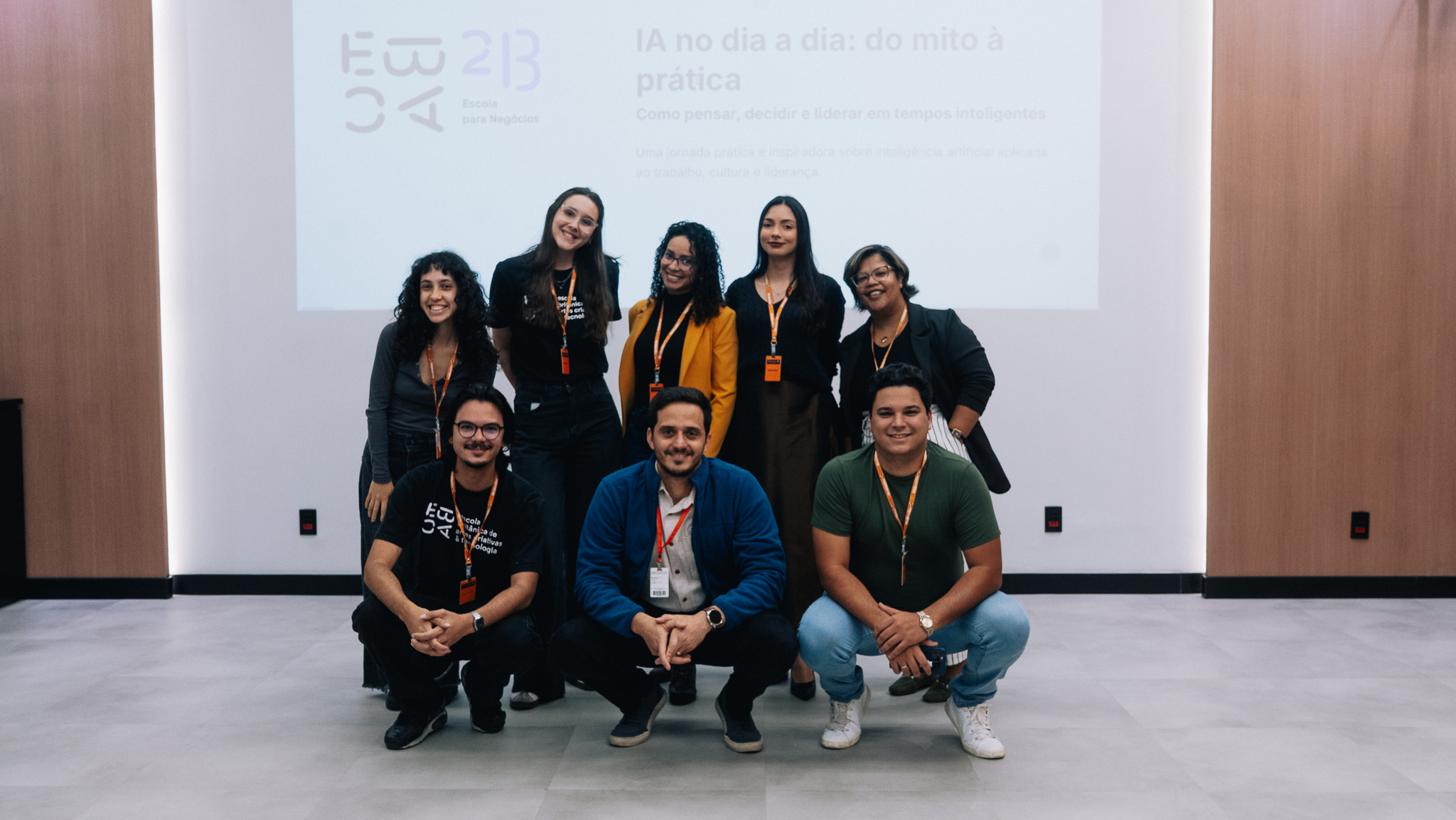
Instructor leading an executive AI workshop
Executive application

AI as a leadership and decision topic, not just a technical tool.

Corporate team after a training session
Team in the field

Hands-on workshops with professionals from leading companies.

Facilitator presenting AI governance concepts
Governance and culture

Building criteria, not just experimenting — from adoption to control.

Group of participants after corporate AI workshop
Real execution

Mixed cohorts of HR, leaders and specialists apply in practice.

Academic and technical coordination

Led by Alan Dantas

Program lead, applied AI consultant and Managing Director of EBAC's Business & Government unit.

Alan Dantas — academic and technical coordinator of the Executive AI Training

Alan Dantas has studied and taught artificial intelligence since 2012 — predictive first, then generative — as a consultant in institutional transformation, executive education and digital-product development for companies and governments.

He was part of EBAC's founding team and now serves as Managing Director of EBAC's Business & Government unit, leading corporate initiatives, executive training, innovation projects, educational solutions and transformation programs with companies, leaders and public institutions.

As academic and technical coordinator of the Executive AI Training for Companies, Alan owns the methodological architecture and is the main lecturer, connecting strategy, governance, organizational culture, data, risk, automation and hands-on AI implementation.

He has worked with AI in 50+ companies of different sizes and sectors, running projects, training and executive immersions. He is also a professor of AI at IBMEC in MBA programs, short courses and executive immersions.

The program also features guest specialists in topics such as AI, innovation, governance, data, organizational culture, digital law, security and automation, according to each cohort's profile.


Enrollment and contact

I want to learn more about the program

Fill in the form and our team will get in touch with information about the next cohort, conditions and a personalized proposal.

Corporate / in-company cohort

Full team or multiple enrollments? Contact us directly on WhatsApp for a personalized proposal.

WhatsApp

Use your work email to speed up our follow-up

With country/area code. We use it for fast follow-up.

Type of interest

To know whether the case is individual, team or corporate cohort

Main AI challenge today

Your data will be used solely to contact you about the Executive AI Training and related EBAC Business proposals. We handle your information confidentially.

Frequently asked questions

Questions about the program

What does HIC mean and why does the name have two meanings?

HIC is an intentional wordplay that represents the two central ideas of the program. The starting point is High Individual Contributor: someone capable of using AI to significantly expand their capacity to analyze, create, decide and deliver. At EBAC, that capacity must be accompanied by Human in Control: people remain responsible for defining objectives, evaluating evidence, reviewing results, setting limits and making decisions. That is why we call our approach the HIC Method: expanding human capability with AI without outsourcing judgment and responsibility to technology.

Who is this program for?

For managers, HR leaders, consultants, innovation professionals and any executive who needs to structure AI within a company — not just use tools day-to-day.

Do I need technical AI knowledge?

You don't need to be an engineer, but you will practice real implementation: architecture, APIs, prototyping, automation, evals and tests. The program teaches what you need to build your case, with mentoring reviewing every technical decision — without becoming an engineering bootcamp.

How do the classes work?

8 weeks of live training, with 16 sessions and 4 individual mentoring sessions, plus a project applied to your real context. Classes are available for review after each session.

What if I can't attend a class?

Sessions are recorded and made available on the platform. You can watch them later and ask questions during individual mentoring.

Can I hire an exclusive cohort for my company?

Yes. Corporate cohorts are structured for full teams, with dates and content adapted to your context. Contact us via WhatsApp for a personalized proposal.

What do I receive at the end of the program?

One cumulative implementation case: you bring a real challenge and finish with a functional, tested and documented solution ready for an implementation decision — plus the capability to repeat the process. Over the 8 weeks you produce evidence milestones (diagnosis, policy, roadmap, tests) that feed this single case.

Is the certificate recognized by the market?

Yes. The certificate is issued by EBAC, a school recognized in the creative and tech market.

Can I pay in installments?

Yes. Up to 12× on credit card. Multiple enrollments, corporate packages and in-company cohorts get personalized conditions — talk to us.

Still have questions? Talk directly to our commercial team.

Chat on WhatsApp
Executive AI Training for Companies | EBAC Business — Products